New videos to celebrate a decade of PATHFINDER

Next year, PATHFINDER will have been working for almost 10 years! And what a ride it’s been!

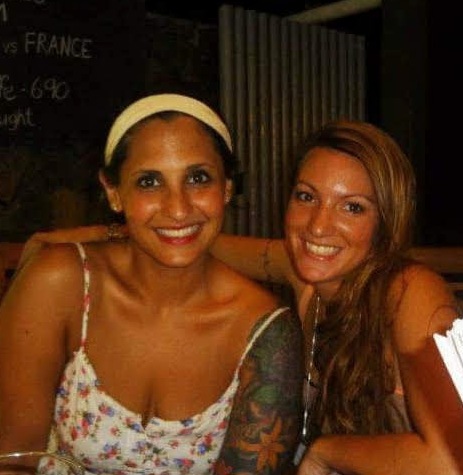
As we enter our next decade of work, we are excited to share these videos about our vision, our values, and why we began this journey in the first place. Our co-founder, Jess, shares her passion for effective development and sustainable transitions. And co-founder, Shivani, explains how she came to work for change by challenging the status quo.

PS: At least one of us is no fan of being on camera (Shivani 👀), so please be kind.
PATHFINDER policy paper explores accelerating social transformation in Africa

We’ve published another policy paper, Accelerating social transformation in Africa: A case for social entrepreneurship, driven by SDG 17Partnership for the Goals. The paper provides an overview of funding resources for social enterprises in Africa, including recommendations to overcome limitations such as access to education, employment opportunities and training and technologies.

The paper aims to answer, “How can a post-pandemic Africa increase the uptake of social enterprises as a means to reduce poverty and accelerate social transformation?” 

You can access it, along with our other policy papers here.

Innovation and Social Design for a Global Impact

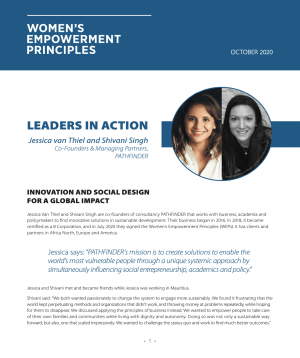
On this International Women’s Day we are excited to share our Leaders in Action piece published by The Women’s Empowerment Principles (WEPs), established by UN Global Compact and UN Women.

The article follows our journey as co-founders of PATHFINDER. It explores our different backgrounds, skills, and strength as a team working together across continents.

The WEPs are a set of Principles offering guidance to business on how to promote gender equality and women’s empowerment in the workplace.

The WEPs are informed by international labour and human rights standards and grounded in the recognition that businesses have a stake in, and a responsibility for, gender equality and women’s empowerment. A set of standards we not only support; we advocate through our social enterprise.

PATHFINDER became signatories of the WEPs in 2020.

Unlocking the potential of social entrepreneurs

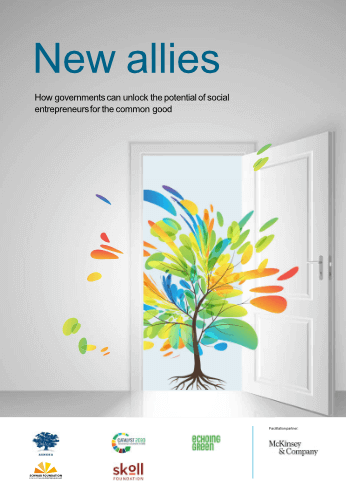
As members of Catalyst 2030, we had the opportunity, along with other social impact stakeholders, to contribute to the report “New Allies: How governments can unlock the potential of social entrepreneurs for the common good” led by industry leaders McKinsey, Catalyst 2030, Skoll Foundation, Ashoka, Schwab Foundation, and others.

The report, published in January 2021, has made good headway since it was presented at last year’s World Economic Forum. It highlights how governments can act in five areas to create supportive ecosystems that unlock the potential of systems social entrepreneurs. Read on here

New Allies report cover


The Last ‘Last Chance’ We Just Had

COP26 just wrapped up. The event had tremendous attention because by now we are well aware that without sweeping, urgent action, climate change will cause catastrophic disruption to our lives, and our world. Every such summit has failed before this one, to accomplish what needed to be done, which further added pressure. So, did we deliver this time? The simple answer is, no. 

Sure; throughout COP26, several initiatives addressing climate resilience were announced, to drive progress towards our shared goal of keeping 1.5ºC within reach. Unfortunately, details and requisite funding were missing. In fact, COP26 saw a great deal of climate pledges, with countries promising to end and reverse deforestation, phase out coal, and reduce methane emissions. Across the board however, policy, planning and funding fell short of these goals.

“Everyone was committed to saving the planet, but there were highly diverging views about how to do it. A welter of announcements on everything from coal to methane to forests dominated the opening days. Large numbers were discussed and ambitious targets were set”. Ian Scoones, Professorial Fellow, Institute of Development Studies

Certainly there were some worthy efforts. Last week, for instance, Edinburgh City joined over 30 cities in the Climate Champion’s Race to Resilience campaign. The UN-backed initiative also launched a metrics framework that allows cities, regions, businesses and investors to measure the progress of their work in building resilience to climate change. Over 2.3 billion people and 100 natural systems and over 100 countries are so far covered by the work being carried out by the Race to Resilience’s partner initiatives.

Private enterprises too, got further engaged. We too believe it is imperative that businesses lead by example. In fact, as a partner of the We Mean Business Coalition, PATHFINDER is one of the 800 businesses to sign the Open Letter to G20 leaders, with asks on 1.5ºC alignment, energy and finance. Building climate resilience is actually critical for small businesses to remain viable, but they often lack the time, funding, staffing and immediate incentives to take action. Large corporations are increasing decarbonization demands for SMEs in order to meet their own net-zero targets by tackling emissions in their supply chains. Corporates and governments must work together to support SMEs and incentivize the transition, ensuring no one is left behind. But even the private sector needs clear, ambitious policies to drive this objective further and faster. 

“The announcements from governments so far on climate action are heading in the right direction. There’s a ratcheting up of ambition but it’s not going far enough.” – Rasmus ValankoLeading systems transformation at We Mean Business.

Citizens, and youth in particular, were seen protesting in cities around the globe, demanding our leaders put aside special interests and do what is necessary to save the world. It is after all, ordinary citizens and youth especially, who must suffer the worst consequences of a heated planet. 

Canadian environmental youth activist, Ta’Kiya Blaney Chegajimixw, spoke of her frustration with this year’s summit, “I’ve been inside these spaces since I was eight. Back then, I ripped up the COP declaration, and I will rip up today’s. Nothing has changed inside this space; it is a performance; it’s an illusion; it’s for convincing the public that something is happening. The climate agreements are actually trade agreements. It’s a way of salvaging global economies based upon colonialism and the extraction of our territories without interrupting them.” – Ta’Kiya Blaney Chegajimixw, Tla’amin Nation Canada, Environmental Activist

It is indeed past time for all nations to demonstrate climate ambition that reduces the degradation of our environment, and (dare we say) reverses it. That we will see enduring damages is certain. How much damage exactly, is something we can still control. We have yet to plan exactly how we will respond to this damage. We do know however, that the solution is to work collectively. That includes our citizens, our enterprises, and our leaders. 

References:

COP26: Two worlds talked past each other — or never even met (theconversation.com)

COP26 delegates, activists, and event workers explain how they feel about the last two weeks of negotiations (businessinsider.fr)

We Mean Business Coalition

Virtual learning opens doors to global industry experience

Given the current global challenges brought on by the COVID 19 pandemic, virtual learning has become the new norm (at least for the time being) in Universities globally.

Although PATHFINDER has always been involved in developing virtual learning programmes, we’ve seen an increase in the demand of theses types of programmes internationally. Including a recent work integrated learning programme we designed with RMIT Australia.

Collaborations such as this are now more important than ever. They’ve been key for students to gain practical business experience as well as a greater understanding of the role of social entrepreneurship in the international development sector.

Students from around the world had overwhelmingly positive feedback on their experience working with PATHFINDER, “I would recommend this kind of experience to other students. It’s a great opportunity to get out of your comfort zone and challenge yourself” said Qihui Wang, studying from China.

Andrew Crane, studying from Australia expressed his interest in, “working for an organisation that works concurrently with industry and academia. This project gave me a good insight into how small, independent organisations like Pathfinder can accomplish this task, especially within constantly evolving political and economic environments.”

Read more about their experience and details of the programme here.

Let’s Get to Work!

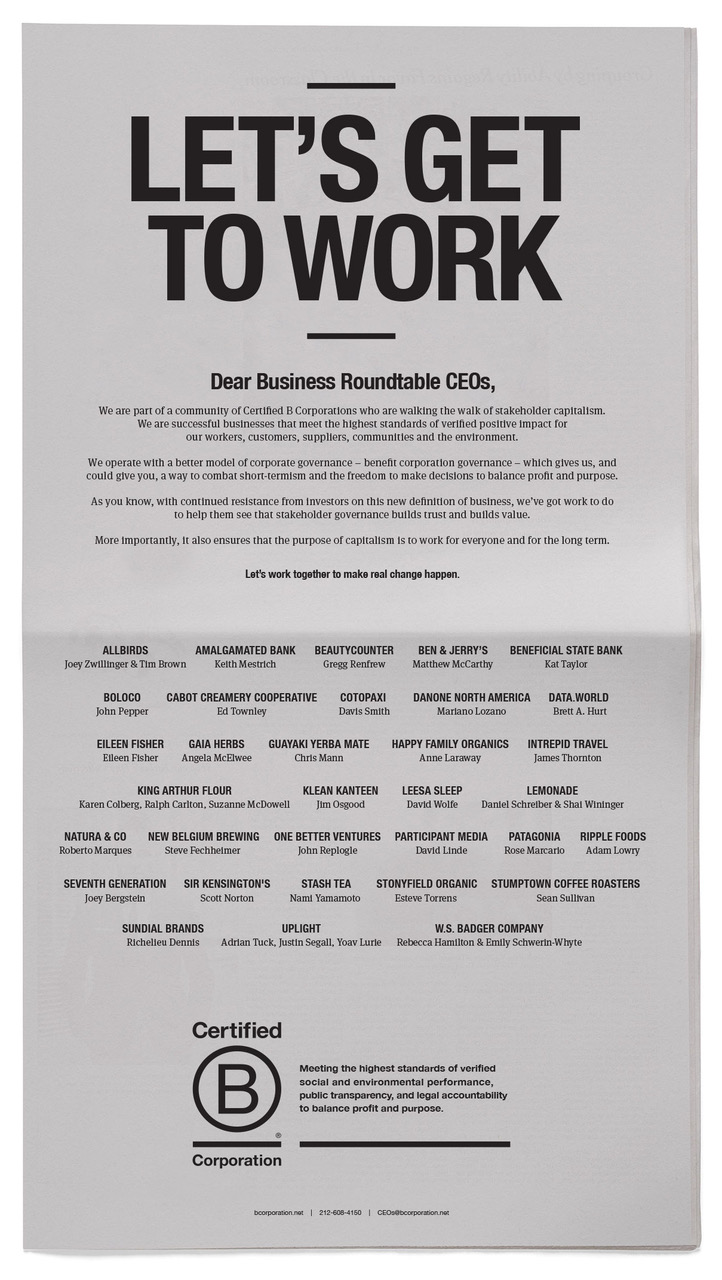
Check out this full page ad in the New York Times about the B Corporations (BCorp) CEO Women’s Group “WeTheChange”.

New York Times We The Change

WeTheChange is a BCorp CEO Women-led group with the mission to address basic human needs through political advocacy, with a focus on economic justice through an inter-sectional lens around race, gender identity, sexuality and class. PATHFINDER is particularly involved in the economic mobility and the social impact measurement subgroups at the moment.

As members of this group, we are hopeful and excited that the movement is escalating! Here’s looking to great possibilities.

We’re Proud to Announce our Paper on Sustainable Development

When we came together to create PATHFINDER, one of our motivations was to build a system that perpetuates solutions that really, truly work. We were done accepting status quo because the status quo is very clearly not enough. Sure, we’re tiny voices speaking to a worldwide industry that is quite set in its ways. But tiny as we may be, we’re here to make a difference. 

This paper was our first endeavor and we’re so proud to publish it. What makes things even more exciting is that Canada’s Impact Investor extraordinaire himself, Joel Solomon, signed on to write a Foreword, having just published The Clean Money Revolution.

We believe our paper is the first of its kind. And so, we hope to inspire meaningful thought, conversation and with a little luck, even change. 

We contend that social entrepreneurship is a far better – and infinitely more promising – response to the calls for global sustainable development, than not-for-profit organizations. Here is why, in summary and in detail. 

We invite you to read and share this publication, and to let us know what you think. We’d love to hear from you!

With Regards,

Jess and Shivani

Announcement: PATHFINDER’s first White Paper

PATHFINDER’s first White Paper: “How to do Sustainable Development Right: The Case for the Social Enterprise”

Have you ever found yourself in a passionate discussion about what works in our global systems, and what doesn’t? Do you ever get frustrated with the state of the world, and wonder why we can’t do better? Do you ever wonder why not-for profit agencies seem slow to evolve with the times? These were some of the questions that would eventually lead to our first white paper. These are also the questions that would lead to PATHFINDER.

We’ve spoken often about how we began PATHFINDER to challenge the models of international development that don’t work, and replace them with those that do. First though, we needed to study. A lot. This paper is a byproduct of that study.

In this paper, we contend that social entrepreneurship is a far better — and infinitely more promising — response to the calls for global sustainable development. We lay out where not-for-profit organizations fall short, and how for-profit social enterprises deliver. And we make a bold call to action for the industry to change.

With this paper, we would love to start a meaningful discussion. We would love for this to inspire collaboration. And we look forward to any opportunities the publishing of our paper creates.

Releasing on May 7th, and introduced by Canada’s most influential impact investor and visionary, Joel Solomon, look out for “How to do Sustainable Development Right: The Case for the Social Enterprise.”

PATHFINDER Logo

PATHFINDER and CIYOTA

PATHFINDER is pleased to announce a new partnership with CIYOTA.

CIYOTA photo.png


“COBURWAS International Youth Organization to Transform Africa’s (CIYOTA) mission is to improve the lives of young people through functional education, socially responsible leadership and social entrepreneurship activities. CIYOTA has established various programs within Kyangwali refugee settlement camp in Uganda to address critical challenges faced by the refugee community such as poverty, violence, disease and insufficient access to quality and functional education.”

CIYOTA focus on three main activities: delivering primary and secondary education to youth, university guidance and women’s empowerment, and community work and involvement.

Most recently, CIYOTA has expanded to the Democratic Republic of Congo (DRC), to help educate children and youth, build communities, and enable entrepreneurs with relevant skills. DRC “is the big country with big problems but also big potential. For 134 years Congo has gone through slavery, assassination, dictatorship and decades of wars. This resulted into 6 million people killed in cold blood and hundreds of women raped. Congo never got a chance to build strong institutions.”

CIYOTA is the incredibly successful passion project of our friend, Bahati Kanyamaza, a former child soldier and refugee himself. We met Bahati a few years ago, and he told us about the story of refugees who grew up in the camps of central Africa, only to one day rescue others from a similar fate.

Bahati and his partners swore to change the world around them. And for so many children and youth, they have!