PATHFINDER Interviews Fellow Social Entrepreneur and Founder of Creators for Good

By Jessica van Thiel

By one perspective, social entrepreneurs are about as good as the people they surround themselves with. Social entrepreneurship is the kind of field that relies, and indeed thrives on collaboration, not competition, with others.

One of PATHFINDER’s first connections was Solène Pignet, the founder of Creators for Good, a social enterprise that provides online consulting services to (aspiring) entrepreneurs committed to making a difference in the world, in financially sustainable ways. From the beginning, Solène demonstrated that collaboration and sharing knowledge with other SocEnts was essential to their combined success. Creators for Good are an excellent example of how working together opens incredible opportunities. And they motivate us to do the same.

Because of this, we thought it would be great to share some of Creators for Good’s insights and lessons learned. Here is some of the most valuable advice we’ve come across on our journey.

What are the most valuable lessons learned since launching Creators for Good?

There are so many! I launched Creators for Good a year and a half ago and I keep learning new things EVERY week, with no exception.

I think one of the main reason may be that at school – or in the French society I grew up in– we don’t prepare for becoming entrepreneurs. We learn to be good employees for corporations, which need lots of qualified obedient workers (and not out-of-the-box thinkers and creators!).

I believe becoming an entrepreneur is a kind of rebellion: it is about not selling your time, your energy and creativity to mainstream companies – who are creating most of our planets problems (environmentally and socially). But instead, spending your time, energy and creativity to contribute to making the world a better place, in a financially sustainable way.

Learning – or convincing yourself – that you don’t need an employer to work, and earn a living, is probably the biggest step of all. However, it’s not the only one!

LESSON #1 Think quality of work, instead of quantity

At school we learn that the more you work, the better. Becoming an entrepreneur means freeing yourself from this limiting belief!

For example, we are used to working from Monday to Friday (in my part of the world). In my previous work I was working from 8am until 8pm (sometimes more). I had a managerial position and a great salary, and I thought it was ‘normal’ to work a lot when you had a lot of responsibilities.

When you become your own boss, you get to set your own rules. Tim Ferris’s “The 4 hour work week” is a great example of this!

However, I do not work 4 hours a week (I love my work way too much for that!), but I am distancing myself from the idea that the amount of hours put in equals the equivalent in results. This translates into the fact that when I started Creators for Good, I was mostly selling my time (clients hire me to work on their project and I would spend X amount of hours helping them). Now, I am developing more and more products that don’t require my own time, so that I can scale my impact without working more (I co-wrote a book for example. Whether we sell 1 copy, 100 copies, or 10 000 copies, our amount of work is exactly the same, and the impact has (almost) no limit).

Now I don’t look at the amount I work, but at the quality: how can I better impact the people I want to help without spending more time working? How can I have a better work-life balance?

pic 1

Creators for Good’s summer office (in the south of France!)

My question to social entrepreneurs is what could you create so that your impact goes beyond the amount of hours you spend (and make your life even more enjoyable than if you had a ‘traditional’ job)?

LESSON #2 Think of what you can do instead of what degree you can get

At school we are taught to study first, get a degree, and then work. Being an entrepreneur doesn’t require any specific degree-and you get to learn along the way!

This is maybe the most limiting belief of all: “Am I ready to start?” “Shouldn’t I be more qualified?” are questions I hear all the time from aspiring entrepreneurs. And it makes perfect sense in a world where the norm is to build your CV, to become an employee.

But when you are an entrepreneur, it’s not your degree that people pay attention to. What people look at, is whether or not your service/product will help them resolve a problem or challenge they face. They only care about themselves, not about you or your qualifications!

For example, you don’t buy bread from the baker that went to the best bakery school, but from the baker who makes the best bread in your area (he may have graduated from a good baking school, but also is using delicious ingredients, has a clean and attractive store, has a smile on his face when you come in to buy bread, etc. In other words, many things that go way beyond the theory of bread making).

With Creators for Good, I invested in a 6 month coaching program at the very beginning, to make sure I set the right foundations to start my business, because I knew my Master’s Degree in Sustainable Development was only good “in theory”.

pic 2

Skype session with my coach Delphine Boileau-Terrien (she lives in the US and I live in Turkey)

Later, I completed training on how to blog (to make sure the hours I spend on writing content actually become useful for the people I wish to help through that medium), social media training (to make sure many people know about the help I can provide), finance training (to not go broke and sustain my impact over time). I also read books, blogs, watched YouTube videos and attended webinars on a weekly basis to make sure I put in place the best practices available for my business and clients.

My question to you is, instead of putting emphasis on your academic background (or wait to finish a degree to launch your own social enterprise), look at all the areas you want to perfect over time. Get started on something that you love and perfect your product/service and it’s delivery along the way. There is no better school than ‘the school of life’ and actual client feedback to know what and how to improve!

LESSON # 3 Think collaboration instead of competition

At school we learn that individuals perform at the expense of others. Only one person gets to be top of the class (or get the best job), and helping others means you diminish your own chances to ‘win’. In entrepreneurship – or at least in social entrepreneurship – helping others is actually the best way to move forward!

When I started Creators for Good, I opened a folder called “competitors”. I used to save all websites I came across, of companies doing the same thing as me (helping social entrepreneurs get started and grow their impact). Sometimes I felt so small looking at all the great work they were doing. Sometimes I wish they didn’t exist.

Until I realised, there is room for everyone! And until the problem I am working on solving (it is hard for people to start their own social enterprise) was not solved, everyone is needed. PLUS every so called competitor could actually become a collaborator, one way or another!

I renamed the folder “potential collaborators” (amongst many other actions) and here’s what happened:

  • Ashoka – the largest network for leading social entrepreneurs worldwide – invited me to moderate one of their conferences in Istanbul.
  • MakeSense – a global association encouraging citizens to solve social entrepreneur’s challenges – invited me to give a conference in France.
  • For my blog I interviewed the co-founder of SocialStarter – an awesome program allowing people to travel and support social entrepreneurs in developing countries.
  • Right now I am writing this article for PATHFINDER!

And those are just a few examples amongst many!

The most successful partnership is the one with Danielle, the founder of theSedge.org. We both are on the same mission: guiding social entrepreneurs get started and grow. We even have the same tool – we work online with individuals around the world. Our formats are slightly different (she offers online courses, I offer 1on1 programs). We could have “competed” on our own. And yet, when we started to work together, awesome things started to happen!

pic 3

Danielle Carruthers & Solène Pignet joining forces during the 1st “Global Socent Lab”

We started with a one-shot online event (where we invited both our communities to join a 1 hour live question-answer session). This transformed into a lively facebook community (with over 500 members in less than a year, and growing every day!) FAR beyond our expectations. We are now working on a common service that we will launch in June 2016 (spoiler: it will be called Changemakers Association).

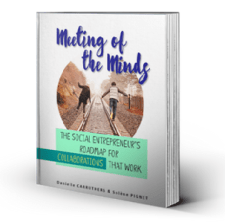
AND we actually wrote a book together! Something that was far out of our comfort zone, but together we felt we had the strengths to make it happen. This book is actually based on our experience of driving a successful collaboration forward as impact entrepreneurs and the tons of research and interviews we did to put together an actionable tool for fellow changemakers. It is called “Meetings of the Minds: the Social Entrepreneur’s Roadmap for Collaborations That Work”.

About Solène Pignet

Portrait Solene - Creators for Good - 2015

Solène is a globetrotter, committed to sustainable development and passionate about alternative entrepreneurship. She founded Creators for Good in 2014. She provides online consulting services to (aspiring) entrepreneurs willing to make a difference in the world, in a financially sustainable way.

Learn more!


For more information about her and Danielle Carruthers’ book, “Meetings of the Minds: the Social Entrepreneur’s Roadmap for Collaborations That Work” visit the website: http://globalsocentlab.com/roadmap-for-collaboration-that-works/
pic 5


150,000 Downloads and Counting!

We are thrilled to announce that our radio interview with Frankie Picasso on her show Mission Unstoppable has had over 150,000 downloads!

This would not have been possible without your support!

And, if you haven’t had the chance to check it out yet, you can here.


Congratulations to Agri-Cycle Namibia!

PATHFINDER wants to extend huge congratulations to our partner project, Agri-Cycle Namibia, for receiving the Total “Startupper of the year” Award. They were selected, along with two other projects, as the winners from Namibia. For more about the award click here.

Agri-Cycle Namibia is a start-up seeking to make a difference in Namibia’s development by creating a Nutrient Recycling industry and providing solutions to environmental issues faced by Namibians, the Namibian Environment, Agriculture and Aquaculture Sectors.

Check out their exciting project!

Way to go, Agri-Cycle Namibia!


So, what’s a socent?

What’s a social enterprise? What do they do, and why are they important?
These are some of the question we come across on a weekly basis. And although social entrepreneurship has become a big part of our lives and who we are, it’s good to check in every now and again to get back to the basics of what social enterprises, or #socents are all about.

Socents in the Development Context

The international development sector, PATHFINDER’s primary focus, has increasingly realized the important role social entrepreneurs have to play in tackling global development issues. But what are social entrepreneurs and how do they fill these industry gaps?

In this context, Devex Impact associate editor, Adva Saldinger, really gets it right.

Check out this short video and learn everything you need to know about social entrepreneurs!

We’ll be speaking at an International Women’s Day Event in the UK!

We’re pleased to announce that Jess has been invited as a guest speaker for the Business Women in Surrey’s (BWiS) Rising Stars Awards Gala in London, on March 8th!

In association with The Surrey Chamber of Commerce, this year’s theme for the BWiS International Women’s Day Celebration is “Rising Stars” celebrating the fantastic work of young businesswomen and entrepreneurs.

We are very excited about the opportunity to share our journey, successes, and challenges with fellow entrepreneurs!


PATHFINDER Chats with Canadian Radio Show

We chatted with radio show host Frankie Picasso on the Mission Unstoppable show on TogiNet Radio live last week.

It was an exciting experience and opportunity to discuss PATHFINDER’s story, awesome projects and way forward!

Check out the interview here!

We’re live Tomorrow on TogiNet Radio

Tune in Tomorrow!

Our radio interview with Frankie Picasso is live on Mission Unstoppable on TogiNet Radio tomorrow from 1:00 to 2:00 pm EST.

Go to www.toginet.com and click on the ‘LISTEN LIVE’ button on the upper right corner to tune in during the live broadcast and listen either from  www.thegoodradionetwork.com, or 48 hours later from itunes.com.

We can’t wait to connect with Frankie Picasso and chat about PATHFINDER’s journey, current projects and way forward!

An Academic’s Perspective On Social Entrepreneurship

By Shivani Singh

Thomas Lyons-1.JPG

Professor Thomas Lyons at Baruch College (CUNY) is trying to launch a program for social entrepreneurship. He’s finding though, that interest amongst students is rather limited.

We suspect it has something to do with the fact that most people are yet unaware of the possibilities in the field. In fact, the possibilities for doing good while generating profit remain largely unknown, especially so for struggling, debt ridden students. First, we must inform people.

Next, to promote a better understanding, Professor Lyons believes “we must talk to people in a language they understand.”

I met with the Professor to explore possibilities for collaboration and we discussed his perspective on the matter.

Social Entrepreneurship’s Industry Hurdles

Professor Lyons believes to be true what we have heard from many others closely related to the field; investors will become keen on funding social enterprises when there are models to a. measure social impact and, b. monitor the transparency of such organizations.

Not only are we watching for innovative financial models to support the industry, but we will also need to measure the corresponding risk and reward effectively. When such information is readily available, more mainstream even, the money should follow.

Social Entrepreneurship In Academia

While the financial hurdles are better known, the academic world faces a massive demographic problem. Professor Lyons points out that currently, “only elite schools have the resources and the demographics to successfully run social entrepreneurship focused programs.” At institutions like CUNY, “kids have to work hard for themselves,” he says.

They attend so that they may learn and succeed in spite of their limited circumstances. Often students are recent immigrants or first generation Americans. Products are not yet tailored to these students and we may still be far off. Also, considering the vast majority of students attend more affordable educational institutions, any developments in academia will likely affect the industry as a whole. It is therefore important, to begin discussions around teaching and researching innovations that generate profit and social impact.

The Future of Social Entrepreneurship

While the obstacles are many, Professor Lyons believes that “the movement is spreading, as evidenced by the new set of thought leaders in this area.” There is a lot more study now. There are more books, articles and people involved. The material and understanding has all expanded. More organizations of all kinds are onboard.

Undoubtedly we are heading in the right direction. The signs state that it’s only a matter of time before the social enterprise ‘movement’ catches on. Eventually, we will come to understand socially driven business as the only way to conduct business. And this will be the day we will be collectively enlightened, happier and more peaceable.

Trend Report: Impact Investing & Social Entrepreneurship in 2016

By Shivani Singh

Joel Solomon

A while ago, I had the distinct opportunity to speak with Mr. Joel Solomon, Renewal Funds Chair & Cofounder, and Hollyhock Chair. He had been so generous with his time and advice for PATHFINDER. Imagine my excitement when he accepted my recent request for a more detailed follow-up interview.

A quick note first: I cannot overstate the importance of the information here, certainly for investors and entrepreneurs alike, but also for various leaders, influencers and for impending decisions that will shape the future of our world.

What are the greater trends?

Is more money being diverted to socially driven businesses? Are people catching on to the benefits of investing for social impact alongside financial gain? Are financiers looking into the feasibility of creative new models?

In general, we are now past vision, invention, and seeding of these ideas. We are in early growth stage. Awareness still remains largely limited to those who are directly involved. However, social entrepreneurship, enlightened investors, the questioning of conventional wealth management assumptions, and emergence of a new generation of values are combining in a powerful formula. This formula is gaining momentum, credibility, proof of concept and initial mainstream acceptance.

There is tremendous opportunity for emerging entrepreneurs to benefit financially from creating ways for people to align their money closely with their values.

Wealth managers are the first to feel the trend via pressure from clients. They’ve struggled to provide comprehensive, satisfactory solutions. Firms are repackaging solutions to highlight their efforts in these directions. New products are being launched. Wealth management firms that understand this demand, its value to the world, and how to relate to clients are gaining strength and growing.

In fact, we are now at an inflection point and cannot be stopped. Socially conscious business and economic practices are to become a given.

Where are the Biggest opportunities?

What areas are investors most excited about? Clean energy has had a lot of the focus thus far. Is that to remain the case for now, or are financiers starting to notice other parts of the industry?

The “Clean Money Revolution”

Every sector of the economy, indeed of how people live on the planet, needs overhaul. Yes, clean energy will be massive.

But so will clean transportation, clean buildings, clean water, clean air, clean food, clean mining, logging, clothing…

Take organic food for example. Decades of early adopters persevered with businesses that grew, processed, manufactured, distributed and retailed organic foods. They worked in virtual obscurity. Only a small committed consumer helped this early stage. Organic food began to show up on grocery shelves. For several decades, organics outgrew conventional food by multiples of sales. Growth steadily picked up velocity. In the last decade it has become a major industry. And yet, in 2015, organic food remains under 10% of the North American food sales. It may be under 2% globally.

Organic food is now unstoppable. The common sense is too compelling. Health, worker safety, chemical runoff into water systems, depleted soil, and an entire system of damaging practices are now facing the threat to reform or die.

The same cycle is steadily evident in renewable energy, efficient transportation, green buildings, carbon pricing, local production, regulations to protect the commons, worker’s rights, taxation and many more systems. Every part of the economy will shift.

Essentially, all solutions that lend to responsible, sustainable living while generating profits?

Yes, exactly.

What are the Biggest hurdles?

Is seed capital likely to remain limited and competitive?

Seed capital will likely always remain competitive. If it were in easy supply, the demand for it would only grow.

Do financiers remain nervous about the risk associated with models in this industry? What advice might best help overcome?

Investors are always nervous about risk. Two things are slowly changing that dynamic. One, wealth holders are learning to ask themselves, “How much is enough?” The other is that the marketplace of socially relevant products and services is getting bigger and smarter.

My advice is to practice reflective inquiry as a first step. Find the meaning of ones’ life. Use a little money for basic security and the rest as a tool for doing good in the world.

What is your best guess for when the concepts of Impact Investing and Social Entrepreneurship will become the mainstream trends everyone wants to get in on?

I do see money rapidly aligning with core values and high purpose. The signs are showing up everywhere and picking up velocity. Smart people are seeing how post-WW2 industrial values were naive and unsustainable. New experimentations are underway around the world, more than that can be tracked, in fact. Demand for sustainability degrees in universities is beating supply. Socially driven businesses are proliferating and expanding. Capital sources that seek these businesses are growing. People who want these products and services are growing even faster.

The visionary, early-adopting risk takers are often the originators of major changes. These are the people who transform the conversation from “it’s impossible” into “that was obvious.” If we can find our way to fair taxation, carbon pricing, regulations to protect the commons, universal health care, education, welfare for those in need, livable minimum wages, responsibility in manufacturing, recycling all waste, protecting natural systems, and terminating machinery that pushes rabid consumption, we may, just may become the ancestors who turned trends towards caring for our future generations.

Ten years from now, we won’t have this conversation. It will all seem redundant. That’s how social change works. Once enough people accept a premise, it is hard to remember how things were ever done differently.

Joel Solomon is President of Renewal Partners and Chairman of Renewal Funds, he is also the co-author, with Tyee Bridge, of the upcoming book by New Society Publishers.

A Great Start to a New Year!

2016 is already off to a great start for PATHFINDER!

We’re signing on with some amazing organizations and working on exciting solutions. Lots of fantastic conversations are happening…All we need now is seed capital to get our own projects off the ground!

Help us spread the word with ‪#‎ImpactInvestors‬ and ‪#‎CSR‬ through our Fundable Campaign!

Thanks for your support! Together we will make our 2016 goals a reality!

-Jess & Shivani